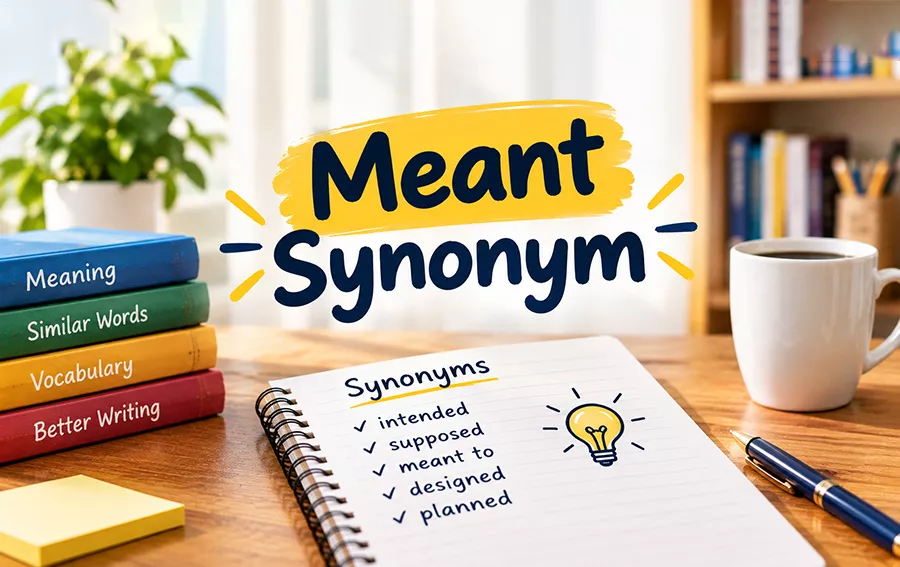
The best synonym for “meant” depends on what you meant by “meant.” If you are talking about a goal, use intended or planned. If you are talking about fate, use destined or fated. If you are explaining what a word or sign stands for, use signified, indicated, or implied.
That small difference matters more than most people think. “Meant” is one of those everyday words that quietly does four or five jobs at once, and a thesaurus will happily hand you a list without telling you which job each replacement can actually do. This guide fixes that. You will see every major meaning of “meant,” the strongest synonyms for each one, and a real example sentence so you can hear how it sounds before you use it.
What Does “Meant” Actually Mean?
“Meant” is the past tense and past participle of the verb mean. It is pronounced like “ment,” and you will see it written the same way in both American and British English. You can confirm the basics on the Dictionary.com entry for “meant”.
Because “mean” covers several ideas, “meant” does too. Merriam-Webster’s entry for mean and meant groups them into a few clear senses:
- To intend or have in mind: “I meant to call you.”
- To be destined or designed for something: “She was meant to teach.”
- To signify or convey: “That red light meant stop.”
- To have importance: “Her opinion meant a lot to him.”
- To be directed at someone: “The gift was meant for you.”
Once you know which sense you are using, picking a synonym becomes easy.
Quick Reference: Synonyms for “Meant” by Meaning
| When “meant” means… | Best synonyms | Example |
|---|---|---|
| Intended | intended, planned, aimed, purposed, had in mind | I intended to finish by Friday. |
| Destined | destined, fated, predestined, bound, foreordained | They were destined to meet. |
| Signified | signified, indicated, denoted, stood for, represented | The flag represented peace. |
| Implied | implied, suggested, hinted, insinuated, conveyed | His tone implied he was upset. |
| Resulted in | entailed, involved, led to, brought about, spelled | The delay led to extra costs. |
| Mattered | mattered, counted, carried weight, was significant | Your help counted for a lot. |
| Designed for | designed for, intended for, made for, aimed at | The book was designed for beginners. |
Synonyms for “Meant” When It Means “Intended”
This is the most common use. You planned to do something, and you are describing that plan after the fact.
- Intended: The safest all-purpose replacement. “She intended to apologize, but the moment passed.”
- Planned: Works when there was a real plan behind it. “We planned to leave at noon.”
- Aimed: Adds a sense of effort toward a target. “He aimed to finish the draft by midnight.”
- Had in mind: Softer and more conversational. “I had a quiet dinner in mind.”
- Was going to: Very casual, great for speech. “I was going to tell you, honestly.”
- Set out to: Suggests a deliberate mission. “She set out to change the rules.”
- Purposed: Formal and a little old-fashioned, so use it sparingly. “He purposed to rebuild the old mill.”
Quick tip: “Intended” and “meant” are almost always interchangeable here, but “intended” sounds a bit more formal. In an email to a client, “I intended to send this earlier” reads more polished than “I meant to send this earlier.” In a text to a friend, “meant” is perfect.
Synonyms for “Meant” When It Means “Destined”
You see this in phrases like “meant to be” or “she was meant for greater things.” The feeling here is fate, not a personal plan.
- Destined: The closest match. “They were destined for success.”
- Fated: Slightly more dramatic. “The two rivals were fated to cross paths again.”
- Predestined: Strongly implies it was decided long ago.
- Foreordained: Formal, often religious or literary.
- Bound: Casual and natural. “She was bound to notice sooner or later.”
- Cut out for: A friendly idiom about suitability. “He was cut out for teaching.”
Synonyms for “Meant” When It Means “Signified”
Here, “meant” explains what a word, symbol, or sign stands for. The vocabulary site Vocabulary.com explains “signify” as a direct way of saying “mean,” and uses symbols like a dove for peace as a clear example.
- Signified: “A green light signified that the road was clear.”
- Indicated: Good for signs, data, and evidence. “The results indicated a strong trend.”
- Denoted: Technical, often used for definitions. “The term denoted a small boat.”
- Stood for: Simple and clear. “The letter P stood for Pakistan.”
- Represented: Works for symbols and ideas. “The tree represented new beginnings.”
- Connoted: Used when the word carries a feeling beyond its dictionary meaning.
Synonyms for “Meant” When It Means “Implied”
Sometimes “meant” describes something suggested rather than said out loud. “Her silence meant she disagreed” is a good example.
- Implied: “His smile implied he already knew.”
- Suggested: A gentler, less certain choice. “The pause suggested she was nervous.”
- Hinted: Works when someone is being indirect on purpose.
- Conveyed: Good for tone or feeling. “Her voice conveyed real disappointment.”
- Insinuated: Carries a negative or sly tone, so use it with care.
Synonyms for “Meant” When It Means “Resulted In”
Think of sentences like “The storm meant a long delay.” The word describes a consequence.
- Entailed: Formal. “The new role entailed more travel.”
- Involved: “The project involved months of testing.”
- Led to: Natural and clear. “The mistake led to a recall.”
- Brought about: “The policy brought about real change.”
- Spelled: Informal and vivid. “The bad weather spelled trouble for the picnic.”
Synonyms for “Meant” When It Means “Mattered”
“That promotion meant everything to her” is about importance, not intention.
- Mattered: “Your support mattered more than you know.”
- Counted: “Every vote counted.”
- Carried weight: “His word carried weight in the room.”
- Was significant: Clear and slightly formal.
“Meant” as an Adjective: Well-Meant and Unmeant
You will also see compounds like well-meant. A thesaurus entry for well-meant lists well-intentioned and well-meaning as the best alternatives, which fits the idea of advice or help that comes from a good place but may not land well.
- Well-meant: well-intentioned, well-meaning, kindly
- Unmeant: unintentional, accidental, inadvertent
- Meant (as in deliberate): intentional, deliberate, purposeful
Formal vs. Casual: Which Synonym Fits Your Writing?
Choosing a synonym is not only about meaning. It is also about tone.
- Formal writing (reports, essays, business emails): intended, signified, denoted, entailed, indicated
- Neutral writing (articles, blogs): planned, implied, stood for, led to, mattered
- Casual speech and texts: was going to, had in mind, bound to, spelled trouble
If your sentence already sounds natural with “meant,” you probably do not need a replacement at all. Swap it only when you want more precision, more variety, or a different tone.
Common Mistakes When Replacing “Meant”
- Using “intended” when you mean “signified.” “The red flag intended danger” sounds wrong. Say “signified danger.”
- Choosing a heavy word for a light moment. “I foreordained to call you” is technically possible, but nobody talks like that.
- Forgetting the preposition. You “intended to go,” but something is “meant for you” or “designed for you.” Check the small words too.
- Writing “meaned.” That is not a word. The past tense of “mean” is always “meant.”
Frequently Asked Questions
The most common alternatives are intended, planned, destined, signified, and implied. The right one depends on whether you are talking about a goal, fate, a symbol, or a consequence.
For intention, use intended. For symbolic meaning, use signified or denoted. For results, use entailed. These all work well in reports, essays, and professional emails.
Often, yes. In the sense of having a purpose, the two are nearly interchangeable. “Intended” simply sounds a little more formal. They do not match when “meant” is used for symbols, as in “that sign meant stop.”
The past tense and past participle of “mean” are both “meant.” For example, “I meant what I said” and “I have always meant well.”
In everyday speech, people say was going to, had in mind, or was planning to. These feel relaxed and natural in conversation.
It depends on the sense. For intention, the opposite is unintended or accidental. For fate, you might say unlikely or not destined.
Final Thoughts
The word “meant” is small, but it carries a lot. Once you separate its meanings into intention, destiny, symbolism, implication, consequence, and importance, finding the perfect synonym stops feeling like guesswork. Match the meaning first, then match the tone, and your sentence will sound exactly the way you meant it.