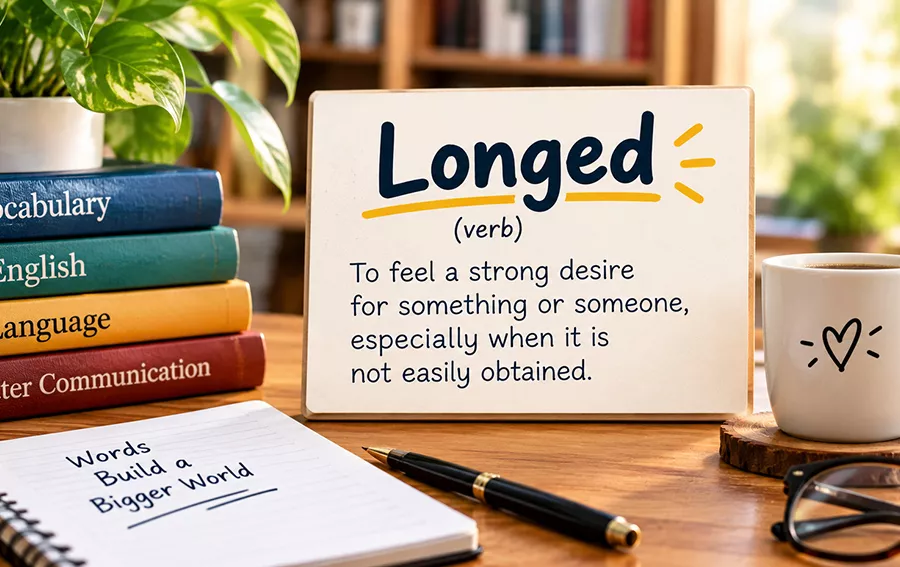
Longed is the past tense and past participle of the verb long. It means to have wanted something deeply, often for a long time, usually something you could not easily have. If someone “longed for home,” they ached to be there. If a child “longed to grow up,” that wish stayed with them day after day.
That is the short answer. But “longed” carries more feeling than a plain dictionary line shows, and people often mix it up with yearned, craved, and wished. So let’s slow down and look at what the word really does in a sentence.
Longed Meaning in Simple Words
Longed describes a strong, heartfelt desire in the past. It is not the kind of wanting you feel for a snack or a new pair of socks. It is the kind that lingers. It sits in the background of your day and tugs at you.
Dictionaries describe the base verb long as wanting something strongly or persistently. Merriam-Webster adds a useful detail: long suggests wishing with your whole heart, and often working toward getting the thing you want. That last part matters. Longing is not always passive.
Here are a few quick ways to think about it:
- Longed = wanted very much in the past
- Emotion level = high, personal, often tender or bittersweet
- Time feeling = the wish lasted, it was not a passing whim
- Usual target = something absent, distant, or hard to reach
Is “Longed” a Verb, an Adjective, or Something Else?
Mostly, it is a verb. “Longed” is the simple past form (She longed for summer) and the past participle (He had longed for this day).
You may also see longed-for with a hyphen. In that form it works as an adjective meaning greatly desired. Vocabulary.com lists wished-for and yearned-for as close matches. A “longed-for vacation” is a vacation someone has wanted for ages.
| Form | Part of speech | Example |
|---|---|---|
| long | Base verb | I long to see the ocean again. |
| longs | Third person present | She longs for a quiet morning. |
| longed | Past tense / past participle | We longed for rain all summer. |
| longing | Present participle / noun | His longing for home grew stronger. |
| longed-for | Adjective | The longed-for letter finally arrived. |
“Longed For” vs. “Longed To”: Which One Do You Use?
This is where most people get stuck, so here is the simple rule.
Longed for + a noun. Use this when the thing you wanted is a person, place, object, or idea.
- She longed for her grandmother’s kitchen.
- The town longed for peace.
- He longed for a break from the noise.
Longed to + a verb. Use this when the thing you wanted is an action.
- I longed to travel the world.
- She longed to tell him the truth.
- They longed to go home.
A quick memory trick: if you can put a thing after it, use for. If you can put an action after it, use to.
Example Sentences Using “Longed”
Seeing a word in real sentences is the fastest way to feel how it works. Here are examples across different moods and settings.
Everyday life
- After a long week at work, I longed for my own couch.
- The kids longed for the school bell on the last Friday of June.
- He longed for a hot meal after hours in the cold.
Relationships and emotion
- She longed for a friend who would simply listen.
- During the deployment, he longed to hear his daughter’s voice.
- They had longed for each other across two time zones and too many missed calls.
Dreams and ambition
- As a teenager, she longed to become a pilot.
- He had longed for a chance like this for years.
- The young writer longed for her first published page.
Storytelling and literature
- The sailor longed for the shoreline he could no longer see.
- She longed for a life that felt like her own.
Synonyms for Longed
Merriam-Webster groups hanker, hunger, pine, thirst, and yearn as close relatives of long. Each one adds its own shade of feeling.
| Synonym | Feels like | Example |
|---|---|---|
| Yearned | Deep, tender, often sad | She yearned for the farm she grew up on. |
| Pined | Sorrowful, wasting away with missing | He pined for his old friends. |
| Craved | Physical or intense, sometimes urgent | I craved something sweet. |
| Hungered | Strong need, almost like a basic drive | They hungered for change. |
| Thirsted | Eager, driven | He thirsted for knowledge. |
| Hankered | Casual, informal | I hankered for a road trip. |
| Ached for | Emotional pain mixed with wanting | She ached for home. |
If you want a word that matches “longed” closely in tone, yearned is usually the best swap. If you want something gentler and more casual, wished or hankered will do.
Longed vs. Yearned vs. Craved vs. Wished
These words overlap, but they are not identical.
- Longed suggests a lasting emotional pull, often toward something missing or far away.
- Yearned is similar, but often a bit more poetic and tender.
- Craved leans toward intense, almost bodily wanting. You crave food, comfort, or relief.
- Wished is lighter. It can be a passing thought with no ache behind it.
“I wished for a sunny day” is a small hope. “I longed for a sunny day” tells us the gray weather had really worn on you.
Where Does the Word Come From?
The verb long sits in the same word family as the adjective long, which meant stretched out or extended in Old English. Etymonline notes that it has cousins in other Germanic languages, including German verlangen, which means “to desire.” The picture is a nice one: wanting as a kind of reaching out across distance. Strong desire feels like stretching toward something that is far away, which fits the way we use the word today.
Common Phrases with “Longed”
- Longed for a long time: wanted something for years
- Had always longed for: a lifelong wish
- Longed-for reunion: a meeting someone has waited a long time to have
- Longed to see / longed to hear: missing a person or place
- Long-awaited and longed-for: both waited for and deeply wanted
Common Mistakes to Avoid
1. Mixing up “longed” and “longer.” They look alike but are unrelated. Longer compares length or time (a longer road). Longed expresses desire.
2. Using “longed” with the wrong preposition. Say longed for a thing or longed to do something. “Longed of” and “longed about” are not standard.
3. Using it for small wants. “I longed for a pencil” sounds odd unless the pencil really matters in the story. Save “longed” for wants that carry weight.
4. Forgetting the hyphen in “longed-for” as an adjective. Write the longed-for answer, not the longed for answer.
Frequently Asked Questions
Longed means wanted something very much, usually for a long time. It is the past tense of the verb long.
It means deeply wished to have or be with something or someone. For example, “She longed for her hometown” means she missed it and wished to be there.
Yes. “Longed” is both the simple past tense and the past participle of the verb long.
“Longed” is the past form of the verb. “Longing” is the present participle (I am longing for you) and also a noun (a deep longing).
Yearned is the closest match. Others include pined, craved, hungered, thirsted, and ached for.
Yes. As a hyphenated adjective, it describes something greatly desired, like a “longed-for promotion.”
Final Thoughts
“Longed” is one of those quiet words that does a lot of emotional work. It tells the reader that a wish was not small, not fleeting, and often not easy to fulfill. Whether you are writing a story, an essay, or just trying to text something heartfelt, reach for it when the feeling is real and has been with someone for a while.
Use longed for with things, longed to with actions, and match it with yearned or pined when you want a slightly different color. Get that right, and the word will do exactly what it is meant to do.