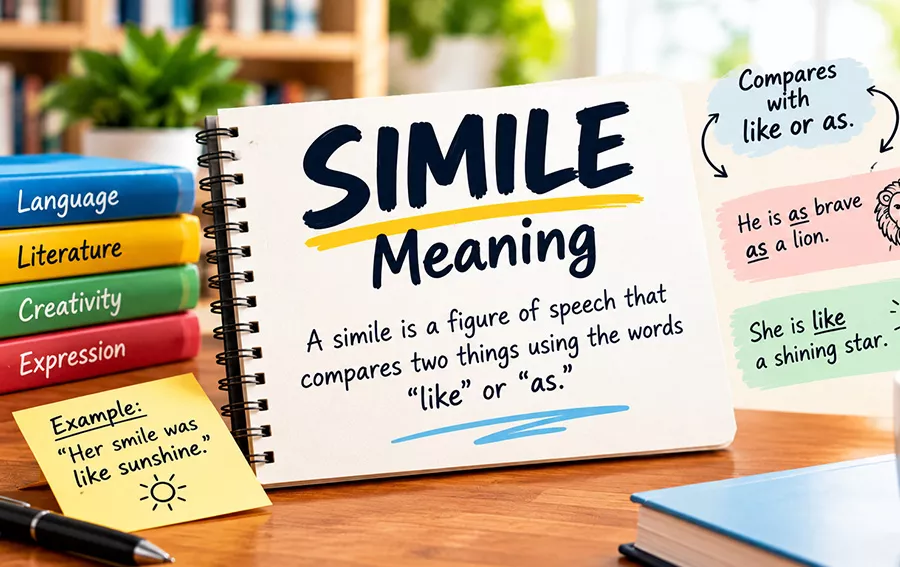
In short: a simile is a way of describing something by comparing it to something else, using the word “like” or “as.” “Brave as a lion” and “runs like the wind” are both similes. The comparison is stated openly, which is exactly what separates a simile from its close cousin, the metaphor.
You’ve been using similes since before you could spell the word. “Sleep like a baby,” “cool as a cucumber,” “fits like a glove,” these little comparisons are so baked into everyday speech that most people never stop to notice they’re doing anything clever at all. But there’s a reason this particular trick of language has survived for thousands of years, in every language humans speak. It works. It takes something abstract or hard to picture and hands it to you in an image you already understand.
Let’s actually break it down properly: what a simile is, where the word came from, how it’s different from a metaphor and an analogy, and enough real examples that you’ll start spotting them everywhere once you know what to look for.
What Is a Simile, Exactly?
A simile is a figure of speech that compares two unlike things, openly, using a connecting word like “like,” “as,” or occasionally “than.” The two things being compared don’t need to actually resemble each other. In fact, the best similes usually pair things that seem completely unrelated on the surface, a person and a fox, a heart and a stone, until the comparison reveals a shared quality that suddenly makes perfect sense.
Take “her laugh was like a bell.” A laugh and a bell have nothing in common physically. But the comparison isn’t about the object, it’s about the quality, the bright, ringing clarity that both share. That’s the actual engine behind every simile: not “these two things are the same,” but “these two things share this one trait, and comparing them lets you feel that trait more vividly than a plain description ever could.”
Worth noting: a comparison only counts as a simile when it’s figurative. “My coffee is as hot as yours” is just a literal comparison, nothing poetic going on. “My temper is as hot as a stovetop” is a simile, because tempers and stovetops aren’t literally the same kind of hot.
Where the Word “Simile” Comes From
“Simile” isn’t a modern grammar-textbook invention. It’s been sitting in English since the late 1300s, borrowed almost unchanged from Latin, where “simile” meant “a like thing” or “a comparison.” That Latin word comes from “similis,” meaning “like” or “resembling,” which is also where English gets “similar” and, through a slightly different path, “simulate.”
Pull the thread further and you land on an old Proto-Indo-European root meaning roughly “together” or “as one,” the same deep root that eventually gave English the word “same.” So in a nice bit of linguistic symmetry, the word we use for “comparing two different things” and the word we use for “two things being identical” grew out of the exact same ancient idea.
Simile vs. Metaphor vs. Analogy
These three get mixed up constantly, and honestly, it’s understandable, they’re all doing similar work. But they’re not interchangeable, and once you see the difference, you’ll never lose track of it again.
- Simile: states the comparison openly, using “like” or “as.” “He fought like a lion.”
- Metaphor: drops the connecting word and just says one thing is the other. “He was a lion in that fight.” Same idea, more direct, a little more forceful.
- Analogy: usually longer and more explanatory, used to make a complicated idea easier to grasp by walking through the similarity in more detail. “Dating is like job hunting, you go through a lot of interviews before you find the right fit.”
A useful way to remember the simile-metaphor split: if you can point to the word “like” or “as” doing the connecting work, you’re looking at a simile. Take that word out and restate it as a flat statement of identity, and it becomes a metaphor.
The Two Main Types of Simile
The short, everyday simile
This is the kind you already know by heart, brief, punchy, usually just a handful of words. “Quiet as a mouse.” “Busy as a bee.” “Light as a feather.” These have been repeated so often they’ve practically become clichés, which is exactly why strong writers tend to build fresh ones instead of reaching for the familiar ones.
The extended, or “Homeric,” simile
Named after Homer, who used this technique constantly in the Iliad and the Odyssey, this is a simile that gets stretched out over several lines, developing the comparison in real detail rather than tossing it off in a phrase. Milton does this in Paradise Lost, comparing Satan’s approach to a wolf stalking a sheep pen, building the image out patiently instead of naming it and moving on. It’s a slower, more deliberate kind of comparison, more common in poetry and literary prose than in everyday speech.
Simile Examples You’ll Actually Recognize
A mix of the familiar and the literary, so you can see the range:
- “Life is like a box of chocolates.” (Forrest Gump)
- “I wandered lonely as a cloud.” (William Wordsworth)
- “O my Luve’s like a red, red rose.” (Robert Burns)
- “Her hair was red as roses.”
- “The snow sparkled like diamonds.”
- “Stubborn as a mule.”
- “Cut like a knife.”
- “Sleeps like a log.”
- “Fits like a glove.”
- “Blind as a bat.”
Notice how many of these have survived for generations. That’s not an accident, a good simile creates such a precise, shareable image that people keep reaching for it long after the person who first said it is forgotten.
How to Write a Simile That Doesn’t Feel Tired
The comparisons above work, but they’re also the first ones anyone’s brain reaches for, which means they’ve lost most of their punch through overuse. A few honest tips if you’re writing your own:
Compare the feeling, not just the object. Instead of “as cold as ice,” think about what the coldness actually feels like in that specific moment, maybe “as cold as a handshake from someone who’s already decided to fire you.”
Pick something the reader can actually picture. A vague or overly abstract comparison doesn’t clarify anything, it just adds another unknown to the sentence. The comparison should always be more familiar than the thing being described, never less.
Don’t force one into every sentence. A page full of similes stops feeling vivid and starts feeling exhausting. Used sparingly, a well-placed simile lands with real weight.
Frequently Asked Questions
What is a simile in simple words?
It’s a way of describing something by saying it’s “like” or “as” something else. “As brave as a lion” and “runs like the wind” are both everyday examples.
What’s the difference between a simile and a metaphor?
A simile uses “like” or “as” to state the comparison openly (“he’s as strong as an ox”). A metaphor drops that connecting word and states it directly (“he’s an ox”). The idea is the same; the delivery is more direct in a metaphor.
Why is it called a “simile”?
The word comes from the Latin “simile,” meaning “a like thing” or “a comparison,” from “similis,” meaning “like” or “resembling.” It’s been part of English since the late 1300s and shares a root with the word “similar.”
Is “life is like a box of chocolates” a simile?
Yes. It directly compares two unlike things, life and a box of chocolates, using the word “like” to draw the comparison. It’s one of the most widely recognized similes in modern pop culture, from the film Forrest Gump.
Can a simile use “than” instead of “like” or “as”?
Yes, though it’s less common. “Quieter than a library at midnight” is still a simile, since it’s a figurative, non-literal comparison, just built with a different connecting word.
What’s an example of a simile that isn’t a cliché?
Anything built fresh for the moment rather than pulled from a list works better than a worn-out one like “busy as a bee.” The strongest similes describe a specific feeling in a way no one’s quite said before, which is also why they’re harder to write than they look.
1 thought on “Simile Meaning: What It Is, Where It Comes From, and How to Spot One”