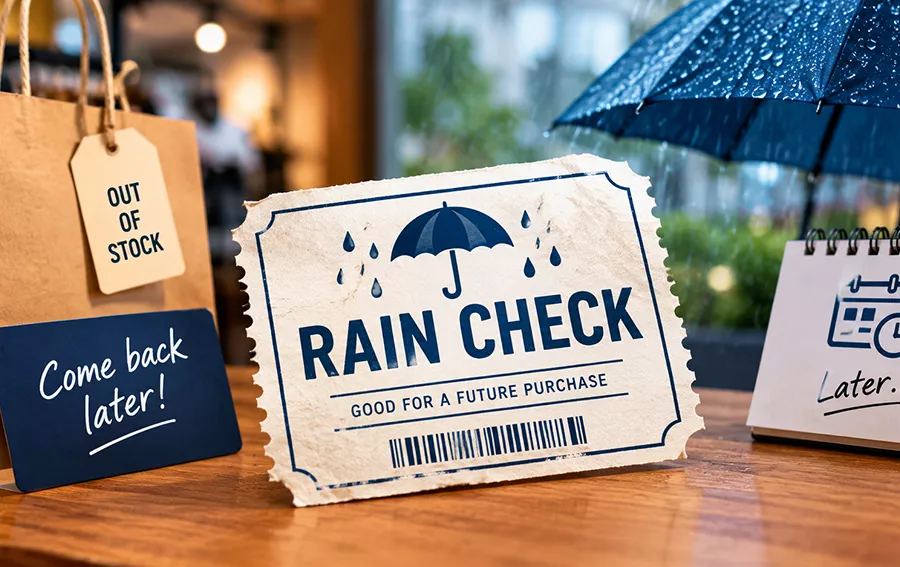
In short: a raincheck is a polite way of postponing something, whether that’s a rained-out baseball game, an out-of-stock sale item a store promises to honor later, or an invitation you can’t accept right now but hope to take up another time. If someone says “I’ll take a raincheck,” they’re not turning you down. They’re asking for a later.
You’ve probably said it without thinking twice about it. A friend asks if you’re free for dinner Friday, and you find yourself saying, “Ugh, I can’t, can I get a raincheck?” It rolls off the tongue so easily that almost nobody stops to wonder why a word about weather ended up meaning something that has nothing to do with weather at all.
So let’s actually slow down and look at it. Where did “raincheck” come from, what does it mean in each of its different lives (yes, it has more than one), and how do you use it so it sounds natural instead of stiff?
What Does “Raincheck” Actually Mean?
At its core, a raincheck is a promise to make good on something later, because right now isn’t going to work. That single idea shows up in three slightly different everyday situations, and knowing which one someone means usually comes down to context.
1. The literal, original meaning: a rained-out game
This is where the word was born. If you bought a ticket to an outdoor baseball game and the weather ruined it before the game became official, the ballpark handed you a small ticket stub called a raincheck. That stub got you into a future game, free of charge, to make up for the one the sky had wrecked.
2. The retail meaning: a promise on a sold-out sale
Walk into a store, find out the advertised sale item is completely sold out, and a good cashier will often offer you a raincheck. It’s a slip of paper (or a note on your receipt) guaranteeing you can still buy that item at the sale price once it’s back in stock, even if the sale itself has technically ended by then. Some retailers skip this entirely and print “no rainchecks” right on the sale flyer, which is their way of saying the discount only applies while supplies last.
3. The everyday, figurative meaning: a polite “not now”
This is the one you’ll hear the most. Somebody invites you somewhere, offers you something, or asks for your time, and you’re just not able to say yes today. “I’ll take a raincheck” (or “can I get a raincheck on that?”) softens the no. It signals that you’re not rejecting the person or the plan, only the timing, and you’d genuinely like to revisit it when things line up better.
Where the Phrase Came From
The baseball connection isn’t a folk theory tacked on after the fact. It’s the real, documented origin. Rainchecks for weather-canceled ball games were already common enough by the late 1870s to show up in print, and by the mid-1880s the practice was well established at American ballparks: a game interrupted or scrapped by rain earned ticket holders a stub redeemable for a future game.
From there, the word did what a lot of good sports slang does: it wandered off the field. Retailers picked it up in the early 1900s to cover the exact same problem in a different setting, a customer showing up for a deal the store couldn’t currently deliver. And somewhere in the decades that followed, people started using it even more loosely, applying it to any invitation or plan that needed to be pushed back rather than canceled outright. There’s a nice example from 1938, when a newspaper reported that President Roosevelt gave a staffer “a rain check on the next cruise” after he had to miss an ocean trip. That’s the figurative, social sense already fully formed, nearly a century ago.
It’s a tidy little story, honestly. A word invented to solve one very specific, very literal problem (what do we do with these tickets now that it’s pouring) ended up giving English a graceful way to say “let’s not lose this, let’s just delay it.”
Rain Check or Raincheck? Which Spelling Is Correct
Both spellings are out there, and both get understood instantly, so this is more of a style question than a right-or-wrong one.
- Rain check (two words) is the older, more traditional form, and it’s still what most major dictionaries and style guides list as the standard entry.
- Raincheck (one word) has been gaining ground for years, the way a lot of English compounds slowly fuse together over time (think “email,” which used to be “e-mail”). It’s now common in casual writing, texting, and increasingly in print too.
If you’re writing something formal, “rain check” is the safer bet. If you’re texting a friend or writing conversationally, either one reads just fine, and honestly, most readers won’t even register the difference.
How to Use “Raincheck” in a Sentence
The phrase is flexible enough to fit almost any tone, from a quick text to a formal email. A few natural examples:
- “I’m exhausted tonight, can we take a raincheck on drinks?”
- “Sorry we couldn’t make the sale price work, here’s your raincheck for when we restock.”
- “The picnic’s rained out, but everyone gets a raincheck for next Saturday.” (a rare case where it’s used almost literally)
- “I’d love to help with your move, but I’m slammed this weekend. Raincheck?”
- “Appreciate the invite to the team dinner. I’ll have to take a raincheck this time, family thing came up.”
Notice the pattern: it’s almost always paired with warmth, not coldness. “Raincheck” works because it keeps the door open. Compare “I can’t make it” (flat, final-sounding) with “can I get a raincheck?” (same message, but it leaves room for a next time).
Common Mistakes People Make With Raincheck
Using it to mean “never.” A raincheck implies a genuine, if unscheduled, intention to follow through. If you have no plans to ever take someone up on the offer, “raincheck” is the wrong word, and most people can feel the difference even if they can’t articulate why.
Treating it as rude. It isn’t. Asking for a raincheck is generally seen as considerate, since it’s a way of declining without shutting the other person down. It only comes across poorly if it’s used repeatedly as a pattern to avoid ever actually committing.
Assuming it always needs “on.” You’ll see it both ways: “take a raincheck on dinner” and simply “take a raincheck” (with the thing being postponed already understood from context). Both are correct.
Confusing it with a refund. In the retail sense, a raincheck is not money back. It’s a guarantee of a future price, not a present-day payout.
Words and Phrases Close to “Raincheck”
None of these are perfect synonyms since “raincheck” carries its own specific flavor of politeness, but they land in similar territory depending on the situation:
- Postpone / reschedule, for the plain, non-idiomatic version of the same idea
- Take a pass (for now), a slightly more casual way to decline with room to reconsider
- Hold that thought, useful mid-conversation rather than for plans
- IOU, closer to the retail sense, a promise of something owed later
Frequently Asked Questions
What does “I’ll take a raincheck” mean?
It means the person can’t do whatever’s being offered or planned right now, but they’d like to do it another time. It’s a polite deferral, not a rejection.
Is “raincheck” one word or two?
Both “rain check” and “raincheck” are used and understood. “Rain check” is the more traditional, dictionary-standard form, while “raincheck” is increasingly common in casual and digital writing.
Where does the phrase “raincheck” come from?
It comes from baseball. In the late 1800s, ticket holders whose game got rained out were issued a raincheck, a stub they could redeem for a future game. The idea later spread to retail (a promise to honor a sold-out sale price later) and then to everyday social use.
Is it rude to ask for a raincheck?
No, quite the opposite. Asking for a raincheck is generally viewed as a courteous way to decline, since it signals interest in following through later rather than a flat “no.”
Can a business refuse to give a raincheck?
Yes. Rainchecks on sale items are a customer-service practice, not a legal requirement in most places, so stores can (and sometimes do) post “no rainchecks” on their sale terms, especially for doorbuster or extremely limited stock.
What’s another way to say “raincheck”?
“Can we reschedule,” “let’s push this to another time,” or “I owe you one” all get close, though none carry quite the same casual, well-understood shorthand as “raincheck” itself.